US Customs Bonds: Continuous vs Single Transaction, and How Much You Need
Before your goods can clear US customs, someone has to post a customs bond. For importers of record shipping containers or large freight to Amazon, Walmart or a 3PL, the choice between a continuous bond and a single transaction bond affects cost, paperwork and how smoothly your shipments clear. This guide explains the rules and amounts, based on CBP's official guidance.
What a customs bond is
According to US Customs and Border Protection's A Guide for the Public: How CBP Sets Bond Amounts (February 2024), a bond is "a performance contract" that protects US revenue and ensures compliance. It is a contract between the importer (the principal) and a surety company, with CBP as the beneficiary. If you don't pay duties or meet your obligations, CBP can claim against the bond. The rules are in 19 CFR Part 113.
Bonds matter beyond formal entry: under 19 CFR 149.5(b), the party filing an Importer Security Filing for ocean cargo must also hold a bond, and the basic importation bond conditions in 19 CFR 113.62(j) set liquidated damages of $5,000 per ISF violation. See our ISF 10+2 guide.
Continuous vs single transaction bond
| Continuous bond | Single transaction bond (STB) | |
|---|---|---|
| What it covers | All covered transactions over a one-year period; renews automatically on its anniversary until terminated | One transaction or activity |
| Amount (Activity Code 1) | Greater of $50,000 or 10% of duties, taxes and fees in the previous 12 months; rounded up by $10,000 to $100,000, then by $100,000 | Generally at least total entered value plus all duties, taxes and fees |
| Duty-free goods | Included in the formula | May be 10% of total entered value |
| Restricted goods | — | 3x the value of the restricted merchandise, minimum $100 |
| Temporary Importation under Bond (TIB) | May need an extra STB for any shortfall | 2x estimated duties including merchandise processing fees |
| Best for | Regular importers (several shipments a year) | Occasional or one-off shipments |
Source: CBP, How CBP Sets Bond Amounts, sections 4 and 6.4.
How the continuous bond amount is set
CBP's formula for the basic importation continuous bond (Activity Code 1) is the greater of $50,000 or 10% of the total estimated duties, taxes and fees in the previous 12 months. Amounts are "rounded up by increments of $10,000 up to $100,000 and then by increments of $100,000." If you had no imports in the past year, the bond is based on your estimate for the next 12 months, and "in no event can the bond amount be less than $50,000." Here is what the formula gives at different import levels:
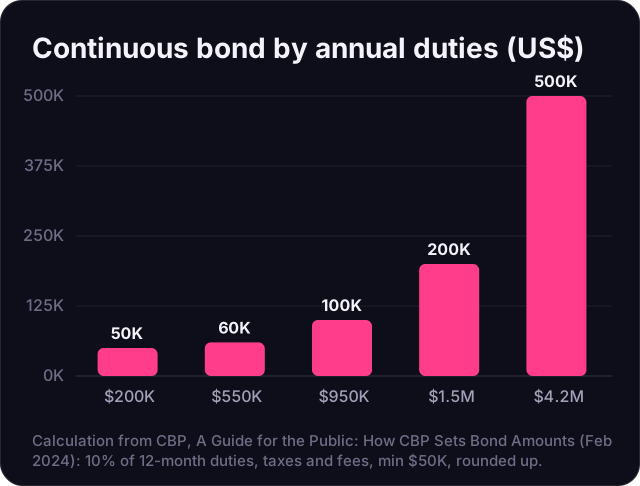
For example, $1.5 million in duties, taxes and fees gives 10% = $150,000, which rounds up to $200,000. CBP also adds amounts for unpaid bills: 10% of delinquent bills under 210 days past due (or protested), and 100% of bills over 210 days or tied to a denied protest, plus 100% of unpaid debit vouchers.
If your duty spend has risen because of recent tariff changes, the 10% calculation rises with it. CBP's Revenue Division reviews bond sufficiency and can issue an insufficiency notice requiring a larger bond.
How a single transaction bond works
An STB generally must be at least the total entered value plus all duties, taxes and fees. Example (calculation): a shipment entered at $40,000 with $10,000 in estimated duties and fees needs an STB of at least $50,000, the same as the minimum continuous bond that would cover a full year. CBP's guide also notes that a single transaction bond amount may only be increased during the 10-day window between entry and entry summary.
Which one should you choose?
- Several entries a year: a continuous bond is usually simpler and avoids buying a new bond for each shipment.
- One trial shipment: an STB can make sense, but compare the premium with a continuous bond quote.
- Ocean freight: you need bond coverage for ISF as well as entry; a continuous bond covers both.
- Restricted or temporary imports: expect higher bond requirements; ask your broker early.
Bond premiums are set by surety companies, not CBP, and vary by amount and risk. Get quotes through a licensed customs broker.
Checklist
- Decide who will be importer of record and get an IRS/EIN number or CBP-assigned number.
- Estimate 12-month duties, taxes and fees from your HTS code and duty rate and import plan.
- Get a bond through a licensed customs broker or surety before the first shipment (and before ISF is filed).
- Review the bond amount when your duty spend rises, especially after tariff changes.
- Pay CBP bills on time; unpaid bills increase the required bond.
- Re-check how your small-parcel flows work after shipping after the end of de minimis.
How Atronia Innovations helps
We help Chinese factories and brands plan US imports and marketplace launches together, and coordinate with your freight forwarder and customs broker so inventory arrives on time. See our logistics services or contact us.