How to Compare Seller Financing Offers: Factor Rates, APR and Hidden Costs

Before every peak season, sellers receive financing offers: from marketplaces, payment companies, banks and online lenders. Some are good value; others cost far more than they appear. The difference is usually hidden in how the price is quoted. This guide shows how to put any offer on the same footing so you can compare them properly.
The main types of seller financing
| Type | How it works | How the cost is usually quoted |
|---|---|---|
| Term loan | Fixed amount, fixed repayment schedule | Interest rate or APR, plus any fees |
| Line of credit | Draw what you need up to a limit; pay interest on what you use | Interest rate on drawn balance, sometimes a draw fee |
| Merchant cash advance / sales-based financing | Lump sum repaid as a share of future sales or payouts | A fixed fee or "factor rate" (for example 1.10) |
| Inventory or purchase-order financing | Funds a specific order, repaid when goods sell | Fee per period or interest rate |
On Amazon, Amazon Lending connects eligible sellers with third-party providers offering lines of credit, term loans and merchant cash advances.
Why a factor rate can be misleading
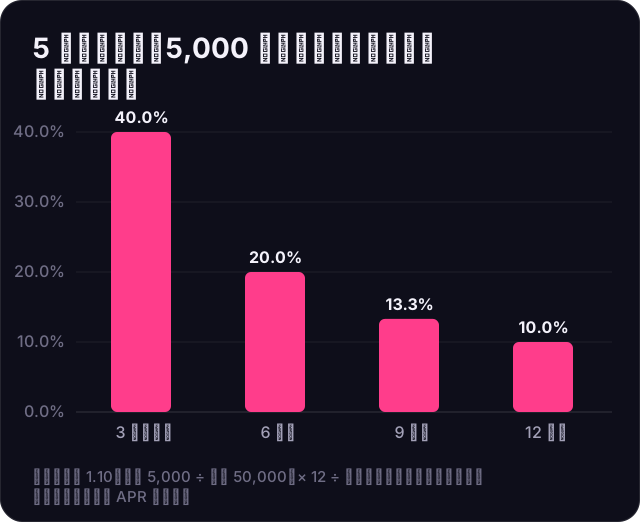
A cash advance with a factor rate of 1.10 means you repay $1.10 for every $1.00 received: a $50,000 advance costs $5,000. That sounds like 10%, but the annual cost depends on how fast you repay. With sales-based repayment, strong sales mean faster repayment and a higher effective cost:
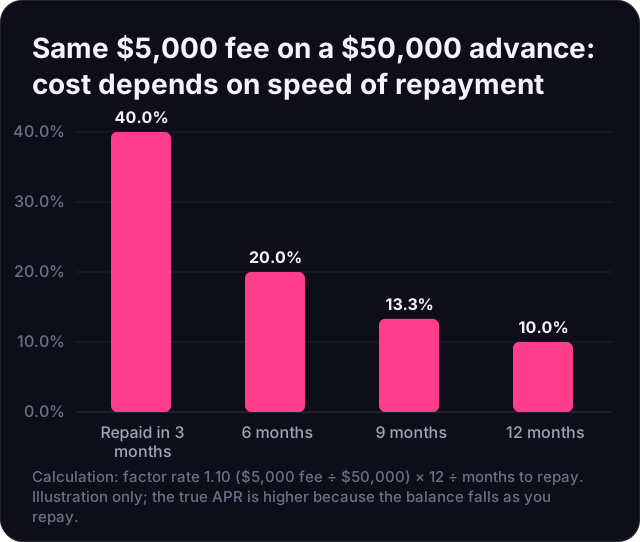
The true annual percentage rate (APR) is even higher than these simple figures, because you are repaying throughout the term and your average balance is lower than the full advance.
What the law requires lenders to disclose
Some states require commercial lenders to show APR-style disclosures. In California, regulations under SB 1235 took effect on December 9, 2022 and require providers of commercial financing offers of $500,000 or less to disclose items including the amount financed, the estimated annual percentage rate, the finance charge, payment terms and prepayment terms, as summarized by the National Law Review and Consumer Finance Monitor. The rules cover sales-based financing such as merchant cash advances. Whether a disclosure applies to you depends on your state and the provider, but you can always ask for the same information.
Five questions to ask about every offer
- What is the total amount I will repay? Including every fee.
- What is the estimated APR? Ask for it in writing, even if not legally required.
- How is repayment collected? Fixed payments, or a percentage of each payout? How large a share?
- Is there a prepayment discount? With many advances, paying early does not reduce the fee.
- What happens if sales drop? Are there minimum payments, penalties or effects on future offers?
Tip: Divide the total fee by the expected months to repay and multiply by 12. If that simple number is already higher than your profit margin on the inventory, the financing will lose money.
When financing makes sense
- Proven products. Funding reorders of a best seller with a known margin and sell-through rate.
- Seasonal peaks. Buying Q4 inventory that you are confident will sell in Q4.
- Short cash gaps. Bridging the time between paying suppliers and receiving marketplace payouts.
It is risky for testing new products, covering ongoing losses or financing slow-moving stock.
A simple comparison worksheet
- Write down each offer's amount, total repayment and expected repayment period.
- Calculate the simple annualized cost for each: fee ÷ amount × 12 ÷ months.
- Ask each provider for its estimated APR and compare.
- Check how repayments affect your weekly or bi-weekly payouts during peak season.
- Choose the offer with the lowest total cost that still fits your cash flow.
For context on recent changes in marketplace lending, see our news on Stripe's acquisition of Parafin.
How Atronia Innovations helps
We help brands plan inventory and ad budgets around real sell-through data, so you only borrow for stock that will turn into sales. Talk to our team before you sign a financing offer for Q4.
Sources
- National Law Review — California approves commercial financing disclosure regulations (2022)
- Consumer Finance Monitor — California DFPI issues final regulations for commercial financing disclosures (Jun 15, 2022)
- Amazon Selling Partners — Amazon steps up financing to fuel seller growth (Sept 18, 2025)