US Trademark Registration for Chinese Sellers: Fees, Rules and Brand Registry
A US trademark is the key that unlocks Amazon Brand Registry, protects your listings from hijackers and gives you a legal basis to act against copycats on Walmart and TikTok Shop too. For Chinese factories and brands, the process has a few extra rules that trip people up. This guide covers who can file, what it costs at the USPTO, and how to use a pending application with Amazon.
Rule 1: foreign applicants need a US attorney
Since August 3, 2019, the USPTO requires all trademark applicants and registrants whose permanent legal residence or principal place of business is outside the United States to be represented by an attorney licensed to practice law in the US. That includes companies in mainland China and Hong Kong. The attorney must stay on record for the application, responses to Office actions and later maintenance filings.
Tip: Be cautious with very cheap filing offers. Ask for the attorney's name and US bar membership, and check that the attorney actually appears on your filing.
What the USPTO charges
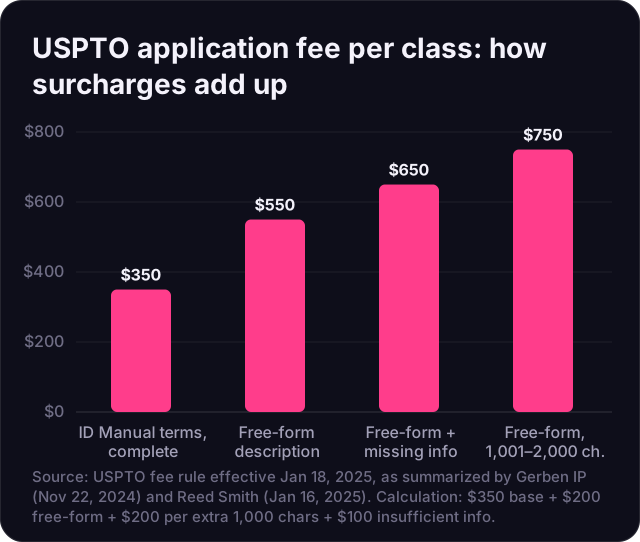
A new USPTO fee rule took effect on January 18, 2025. According to summaries by Gerben IP and Reed Smith, the old TEAS Plus and TEAS Standard options were replaced by a single $350 base fee per class, plus surcharges:
- $100 per class if the application is missing required information.
- $200 per class if you write your own description of goods instead of using terms from the USPTO's ID Manual.
- $200 per class for each additional 1,000 characters of free-form description.
The chart shows how these add up for one class:
Gerben IP also lists later fees per class: $150 for a Statement of Use (for intent-to-use applications), $300 for the Section 8 declaration and $350 for the Section 9 renewal. These are government fees only; attorney fees are separate. Fees can change, so check the USPTO fee schedule before filing.
How Amazon Brand Registry fits in
According to Amazon's Brand Registry page, you need "an active, registered trademark or a pending trademark application" from the trademark office of a country with an Amazon store. The mark must be a word mark or a design mark containing words, letters or numbers, and the brand name on your products or packaging must match the trademark record exactly. You must be the trademark owner; an agency should be added as a user after the owner enrolls.
In practice, many sellers enroll with a pending US application and complete registration later. Amazon's IP Accelerator can also connect you with vetted law firms if you don't yet have a trademark.
Step-by-step checklist
- Pick a distinctive name. Invented words are easier to register than descriptive ones. Avoid names that simply describe the product ("Best Kitchen Knife").
- Search first. Have your attorney search the USPTO database for identical or similar marks in related classes before filing.
- Choose classes carefully. Each class costs another base fee. Cover what you sell now and what you realistically plan to launch.
- Use ID Manual terms where possible to avoid the free-form surcharges.
- Decide the applicant. File in the name of the entity that will own the brand and the Amazon account. Changing owners later adds cost and paperwork.
- Prepare specimens. For a use-based application you need proof the mark is used in US commerce, such as product or packaging photos showing the brand.
- Enroll in Brand Registry with the serial number once the application is filed, and keep the brand name identical everywhere.
- Diary the deadlines. Office action responses, Statements of Use and maintenance filings all have strict deadlines.
Common mistakes
- Filing in a personal name while the Amazon account belongs to a company.
- Spelling or spacing of the brand differs between the trademark, packaging and listings.
- Filing too many classes "just in case," then paying renewal fees for all of them.
- Letting an agent or supplier file in their own name, so they, not you, own the brand.
How Atronia Innovations helps
We don't provide legal services, but we coordinate the brand side for clients: naming checks with your attorney, Brand Registry enrollment, A+ content and brand protection once you are live. See how our Brand Accelerator works, or talk to our team in Los Angeles or Shenzhen.
Sources
- USPTO — New trademark rule requiring foreign-domiciled applicants and registrants to have a U.S.-licensed attorney (Jul 2, 2019)
- Federal Register — Setting and Adjusting Trademark Fees During Fiscal Year 2025 (Nov 18, 2024)
- Gerben IP — USPTO trademark fee changes for 2025 (Nov 22, 2024)
- Reed Smith — USPTO announces trademark fee increases effective January 18, 2025 (Jan 16, 2025)
- Amazon — Brand Registry: eligibility