LTL Freight Class Explained: How Density Sets Your Shipping Cost for Bulky Items
If you sell furniture, fitness equipment, appliances or anything shipped on a pallet, your freight bill depends heavily on one number: the freight class. Since July 2025, that class depends more on density than ever before, and a few inches of packaging can move your shipment into a more expensive class. Here is how LTL freight classes work and how to keep them, and your costs, down.
What LTL and freight class mean
Less-than-truckload (LTL) freight is shipping that fills only part of a truck, typically one or a few pallets. LTL carriers price shipments using the National Motor Freight Classification (NMFC), managed by the National Motor Freight Traffic Association (NMFTA). Classes run from 50 to 500; the lower the class, the cheaper the freight usually is per pound, because dense freight uses truck space efficiently.
When should you use LTL instead of parcel? Very heavy or oversized items, and multiple boxes going to the same address, are often cheaper as a single palletized LTL shipment. Get both quotes for your most common order types before deciding.
The 2025 density scale
According to Cole International and carrier Old Dominion, NMFC Docket 2025-1 took effect on July 19, 2025. It moved many products to density-based classification and expanded the density scale from 11 to 13 tiers, adding classes 55 and 50 for very dense freight:
| Density (lb per cubic foot) | NMFC class |
|---|---|
| Less than 1 | 400 |
| 1 to under 2 | 300 |
| 2 to under 4 | 250 |
| 4 to under 6 | 175 |
| 6 to under 8 | 125 |
| 8 to under 10 | 100 |
| 10 to under 12 | 92.5 |
| 12 to under 15 | 85 |
| 15 to under 22.5 | 70 |
| 22.5 to under 30 | 65 |
| 30 to under 35 | 60 |
| 35 to under 50 | 55 |
| 50 or more | 50 |
Source: NMFC 13-sub density scale as published by Cole International, July 2025. Some products still have their own NMFC item class that is not based on density; check with your carrier or the NMFTA.
How to calculate density
- Measure the shipment as it will travel, including the pallet: length × width × height in inches.
- Divide by 1,728 to get cubic feet.
- Divide the total weight in pounds by the cubic feet. The result is pounds per cubic foot (pcf).
- Find the class for that density in the table above.
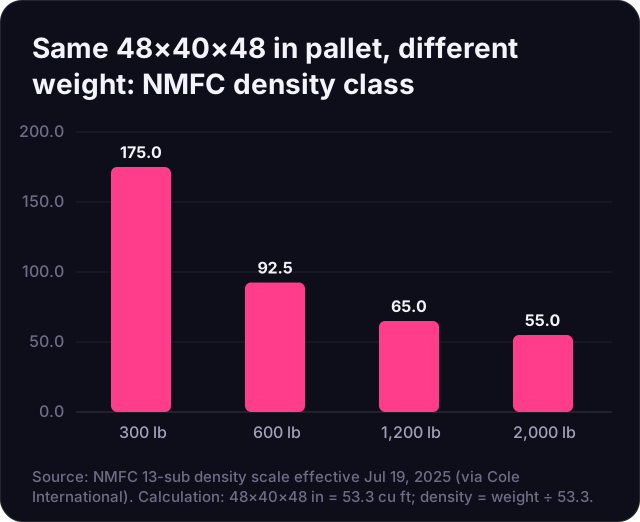
Example: a 48 × 40 × 48 inch pallet is 53.3 cubic feet. The chart shows how its class changes with weight:
Ways to lower your freight class
- Cut empty space. Oversized cartons and pallets with overhang increase volume without adding weight, lowering density.
- Build full, square pallets. Stack evenly and avoid pyramid shapes; carriers measure the outer dimensions.
- Ship knocked-down or flat-packed where possible; furniture that ships flat is much denser.
- Combine SKUs on one pallet when they go to the same destination.
- Use the right pallet height. Many carriers charge by the space a pallet takes, so very tall, light pallets are expensive.
Watch the accessorial fees
For e-commerce, the base rate is only part of the cost. Delivering to homes often needs extra services that carriers charge separately, such as liftgate, residential delivery, delivery appointments and inside delivery. Ask for these to be listed in every quote. Amazon now sells LTL labels through Buy Shipping; see our news on Amazon and Walmart bulky shipping.
Avoid reclassification charges
Carriers inspect and re-weigh shipments. If your declared class or weight is wrong, they can reclassify the shipment and bill the difference, often with an inspection fee. Keep accurate dimensions and weights per SKU and per pallet configuration, and update them when packaging changes.
Tip: Build a simple sheet per pallet configuration: dimensions, weight, density and class. Recalculate it whenever you change cartons or pallet patterns.
How Atronia Innovations helps
We help sellers plan US fulfillment for every product size and compare freight and parcel options before peak season. See our logistics services or talk to our team.