NRF Port Tracker: US Imports Peaked in September, Slower Months Ahead
US retail imports had their biggest month of the year in September, but the extended 2026 import peak is now winding down. The latest Global Port Tracker from the National Retail Federation (NRF) and Hackett Associates, released on November 9, 2026, forecasts lower monthly volumes from November through March. For sellers who stock US warehouses and FBA, this tells you a lot about container space, rates and timing for spring inventory.
What the November Port Tracker says
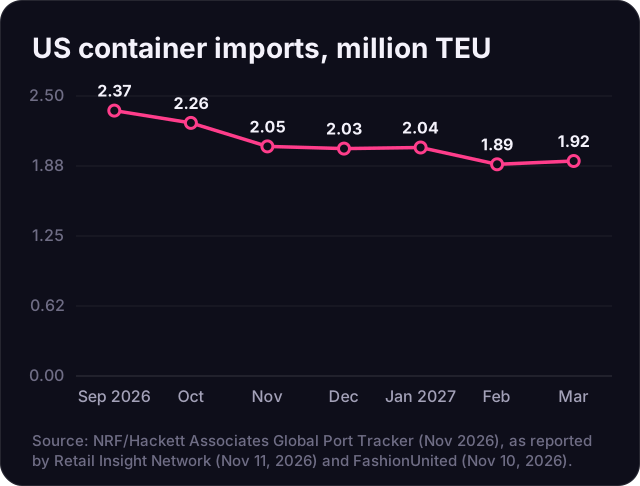
According to Retail Insight Network's November 11 report on the NRF/Hackett data, US ports covered by the tracker handled 2.37 million TEU (twenty-foot equivalent units) of loaded imports in September 2026. That was up 3.4% from August and up 12.6% year over year. It was the busiest month of 2026 and the third-busiest month on record, behind only May 2022 (2.4 million TEU) and July 2025 (2.39 million TEU).
The forecast for the following months:
- October 2026: 2.26 million TEU, up 9.1% year over year.
- November and December 2026: 2.05 million and 2.03 million TEU, both slightly above 2025. FashionUnited puts the year-over-year gains at 1.2% and 1.3%.
- January 2027: 2.04 million TEU (down 3%); February: 1.89 million (down 0.5%); March: 1.92 million (down 11.2%).
- Full year 2026: about 26 million TEU, up 2% from 25.4 million in 2025. The first half of 2026 totaled 12.7 million TEU, up 1.1%.
Both reports attribute the shape of the year to tariffs. Hackett Associates founder Ben Hackett said the Supreme Court decision striking down the "Liberation Day" tariffs eased pressure early in 2026, and that new tariffs announced in the second quarter then drove a surge in imports from May to mid-October. NRF Vice President for Supply Chain and Customs Policy Jonathan Gold said, as quoted by FashionUnited: "Nonetheless, most holiday merchandise is already here, and retailers are working closely with their supply chain partners."
How the forecast changed in a month
NRF's October 8 release had already said the extended peak was "wrapping up." Compared with that edition, the new forecast raises November and the full-year total, and trims January and February slightly:
| Month / period | October 8 forecast | November forecast |
|---|---|---|
| November 2026 | 2.00M TEU | 2.05M TEU |
| December 2026 | 2.02M TEU | 2.03M TEU |
| January 2027 | 2.07M TEU | 2.04M TEU |
| February 2027 | 1.92M TEU | 1.89M TEU |
| Full year 2026 | 25.8M TEU | 26.0M TEU |
In October, Gold said "we're likely past the busiest part of the year," and Hackett noted that "core economic indicators are broadly flat or weakening slightly month over month." The November numbers confirm that direction: the peak lasted longer than usual, but volumes are stepping down.
Labor watch at Los Angeles and Long Beach
Retail Insight Network also reports that ILWU Local 26, which represents watchmen at the ports of Los Angeles and Long Beach, has agreed to a third short-term contract extension, to November 20, 2026. Its previous contract expired in July 2025. No disruption has been reported, but it is worth following if your containers are scheduled to arrive at San Pedro Bay in late November.
What it means for sellers (our analysis)
- Holiday stock is mostly landed. If your Q4 inventory is not already in the US, plan for domestic replenishment, not ocean. Check carrier holiday shipping deadlines for last-mile cut-offs.
- Softer early-2027 volumes can mean more negotiating room. A March forecast down 11.2% year over year suggests less competition for space around and after Lunar New Year. This is our reading, not a rate forecast; quote with several forwarders before you book.
- Policy still drives volume. 2026 showed how quickly tariff news pulls imports forward. Keep watching the Section 301 exclusions and port-fee suspension that run to January 2027.
- Don't over-order on a strong September. Much of that volume was tariff-driven front-loading, not a sign of stronger consumer demand.
Checklist for the next 60 days
- Reconcile what is in transit against Q4 sell-through forecasts; move slow stock to promotions rather than storing it into peak storage fees.
- Book spring (pre- and post-Lunar New Year) shipments early, while asking forwarders for quotes on softer lanes.
- Confirm your HTS codes, country-of-origin marking and ISF filings are clean, so cargo is not held when it does arrive.
- If you use LA/Long Beach, ask your forwarder for an update on the ILWU Local 26 extension after November 20.
How Atronia Innovations helps
We help Chinese factories and US brands plan inventory against marketplace demand, so stock arrives when it can sell instead of sitting in storage. Our team also offers discounted US last-mile and international labels for domestic replenishment. See our logistics services or talk to us about your spring plan.