Amazon Holiday Returns: A Seller's Guide to the Extended Window
Every year, the money you make in November and December is not final until the end of January. Amazon extends its return window for holiday purchases, and online orders already come back more often than store purchases. This guide explains how the extended holiday returns policy has worked, what the data says about return rates, and a practical plan to protect your Q4 margin.
How Amazon's extended holiday returns work
Amazon's normal policy lets customers return most items within 30 days of delivery. For the holidays, Amazon has extended that window for several years in a row. For the 2025 season, Amazon's notice to sellers said items bought between November 1 and December 31, 2025 were returnable through January 31, 2026, with Apple-brand products returnable through January 15, 2026, as reported by Value Added Resource (updated Oct 14, 2025).
Three details matter for sellers:
- It covers FBA and seller-fulfilled orders. Amazon's notice said the extended window applies to seller-fulfilled, FBA and Amazon retail orders.
- Only the deadline changes. Amazon stated that "returns eligibility for all orders remains the same." Items that are not returnable (for example, Final Sale, perishable or customized items) stay non-returnable.
- The start date has moved. In 2022, Amazon announced an October 7 start that would have caught October sale purchases, then changed course after seller pushback, according to Value Added Resource; in 2023, 2024 and 2025, the window started on November 1.
| Season | Purchases covered (US) | Return by |
|---|---|---|
| 2023 | November 1 – December 31 | January 31, 2024 |
| 2024 | November 1 – December 31 | January 31, 2025 |
| 2025 | November 1 – December 31 | January 31, 2026 (Apple: January 15) |
Source: Amazon seller notices as summarized by Value Added Resource. As of October 9, 2026, we have not seen Amazon's announcement for the 2026 season; last year the US notice was confirmed in mid-October. Check Amazon's Extended Holiday Returns help page and Seller Central News for the current dates before you plan around them.
What the data says about return rates
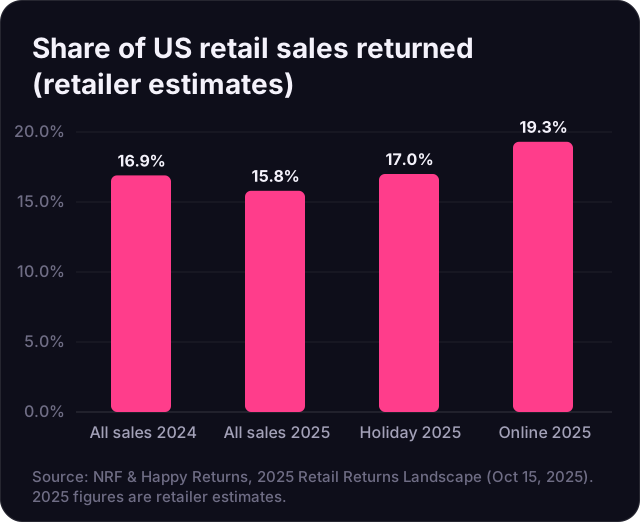
The National Retail Federation and Happy Returns (a UPS company) surveyed 358 e-commerce professionals at large US merchants for their 2025 Retail Returns Landscape (Oct 15, 2025). Retailers estimated that 15.8% of 2025 sales would be returned, totaling $849.9 billion, compared with 16.9% and $890 billion the year before. Online orders are higher, at an estimated 19.3%, and retailers expected about 17% of holiday sales to come back.
The same report found that 9% of all returns are fraudulent, and that 82% of consumers call free returns a major consideration when buying. In other words, a smooth return process helps sales, but holiday returns are large enough that sellers need a plan for them.
Plan your holiday returns in five steps
1. Budget for returns in your Q4 pricing
Use your own return rate by SKU from last November–January, not just the national average. Build it into your deal prices: a 20% discount on a product with a 15% return rate leaves much less margin than the sticker suggests. Remember that sales from November and December may be reversed in January, so do not spend Q4 profit before February.
2. Prepare for FBA returns
For FBA orders, Amazon receives the return and decides whether the unit is sellable. Review your FBA customer returns report every week in January, and check that returned units that should be resaleable go back into stock. If a return was refunded but the item never came back, or came back damaged by the carrier or warehouse, look at whether you are eligible for a reimbursement under Amazon's FBA policies.
3. Get seller-fulfilled returns ready
If you ship orders yourself, make sure your return address and return settings in Seller Central are correct before November, and that someone will process return requests over the holidays. Decide in advance how you will handle low-value items where return shipping costs more than the product.
4. Reduce avoidable returns
Many returns come from wrong expectations. Before the holiday traffic arrives, check size charts, dimensions, compatibility notes and the main images. Read last season's return reasons and fix the top two causes in your listing.
5. Watch for fraud and abuse
Given the 9% fraud estimate, track returns that come back empty, swapped or used. Keep photos of high-value items before shipping and file claims quickly with evidence.
Holiday returns checklist
- Pull last year's return rate by SKU for November–January.
- Add expected returns to your deal and ad budget calculations.
- Confirm return address, settings and holiday staffing for seller-fulfilled orders.
- Fix the top return reasons in listings before Black Friday.
- Check Amazon's 2026 holiday return dates once announced.
- Review FBA returns and reimbursement eligibility weekly in January.
How Atronia Innovations can help
Our account managers track returns, reimbursements and listing fixes as part of running your Amazon store, so Q4 growth does not disappear in January. For seller-fulfilled orders, we also offer discounted US labels for shipping. Talk to us about your holiday plan, or read our Prime Big Deal Days 2026 results.
Sources
- NRF — Consumers expected to return nearly $850 billion in merchandise in 2025 (Oct 15, 2025)
- Value Added Resource — Amazon extended holiday returns begin November 1, 2025: what sellers need to know (Oct 6, 2025, updated Oct 14, 2025)
- Amazon Seller Central — Extended Holiday Returns policy (help page)