Amazon Transparency and Project Zero: How Brands Stop Counterfeits
Counterfeits and look-alike listings can take sales and reviews from a brand in weeks. Amazon offers two programs to fight back: Transparency, which puts a unique code on every unit, and Project Zero, which lets brands remove counterfeit listings themselves. This guide explains how each works, what it costs and who qualifies, based on Amazon's official Transparency and Project Zero pages.
Transparency vs Project Zero at a glance
| Transparency | Project Zero | |
|---|---|---|
| What it does | Unique serial code on every unit; units without a valid code can't be listed or shipped | Self-service tool to remove counterfeit listings immediately, plus automated protections |
| Cost | No enrollment, subscription or minimum; $0.05 / $0.03 / $0.01 per code by volume tier | Free tool and automated protections; Transparency codes paid separately |
| Key eligibility | Brand Registry; brands from 10 origins including China and the US | Registered trademark in Brand Registry; Report a Violation use in last 6 months with ≥90% acceptance |
| Ongoing requirement | Pass an operational performance review before protections go live | Keep a removal accuracy rate of at least 99% |
| Coverage | 10 Amazon stores (US, CA, DE, FR, IT, ES, UK, AU, IN, JP) | 22 countries' stores, including the US |
| Scale (Amazon figures) | 90,000+ brands enrolled; 2.7 billion+ units verified | — |
Sources: Amazon Transparency program page and FAQ and Project Zero page and FAQ, accessed November 16, 2026.
How Transparency works
Amazon describes Transparency as "a product serialization service and anti-counterfeiting program." Every unit of an enrolled product carries a unique code. Once protections are active, "a valid Transparency code must accompany every unit listed or shipped" in Transparency-supported stores, whether the order is fulfilled by Amazon or by the seller. Amazon says codes can also stop "materially different" versions (different materials, compatibility, color or language) and products made for other countries' stores from passing listing checks.
You can use Amazon-issued codes (a small square barcode that customers can scan with the Amazon Shopping or Transparency app) or connect your existing serial codes. App scanning by customers is only available with Amazon-issued codes. For China-based sellers, Amazon lists "regional integration partners (China only)" that connect Transparency to ERP systems.
Protections are not active until your product passes an operational performance review. For FBA, codes are scanned when units arrive at the fulfillment center; for self-fulfilled orders, you provide codes at order confirmation in Seller Central.
What Transparency costs
There is no enrollment fee, subscription or minimum; you pay only for codes. Amazon's published price per code:
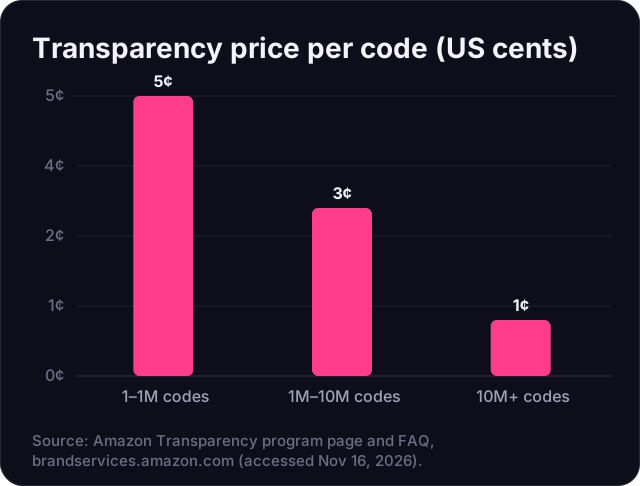
Example (calculation): 50,000 units in a year at the first tier cost 50,000 × $0.05 = $2,500 in codes, before labeling or printing costs. Tiers reset each year on your account creation date.
How Project Zero works
Project Zero gives eligible brands a self-service tool to "search for counterfeit listings and immediately remove them." Each removal also strengthens Brand Registry's automated protections. Enrollment requires a 10-minute training. Amazon recommends a test buy to confirm a violation, and it sends a notice of complaint to each seller affected by a removal.
The tool is only for counterfeits, meaning unlawful use of a registered trademark. It is not for patent, copyright or pricing disputes. Brands must keep an accuracy rate of at least 99% to keep access, and eligibility requires at least a 90% acceptance rate on Report a Violation submissions in the last six months.
Which one should you use?
- Frequent counterfeits or hijacked listings: Transparency gives the strongest protection because units without valid codes are blocked.
- Occasional counterfeit offers: start with Report a Violation, build a clean record, and enroll in Project Zero when invited.
- High-value or regulated products: combine both; Amazon says brands using both "see the best results."
Checklist
- Secure a US trademark registration and enroll in Brand Registry (see our Brand Registry growth tools).
- Decide which SKUs to serialize first: bestsellers and products with counterfeit history.
- Choose a labeling method: self-print, pre-printed labels, co-packer, or print on packaging.
- Coordinate codes with your factory so every unit is labeled before shipping; keep GS1 barcodes and Transparency labels separate and scannable.
- Run the operational performance review before relying on protections.
- Report violations accurately to qualify for Project Zero, and test-buy before removals.
How Atronia Innovations helps
From Los Angeles and Shenzhen, we help brands set up Brand Registry, Transparency labeling with their factories, and ongoing listing protection on Amazon. See our Brand Accelerator or contact us.