Prime Big Deal Days 2026 Results: $9.86B Online, Deeper Discounts
Amazon's October Prime Big Deal Days ran on October 6–7, 2026, and the first full numbers are in. According to Adobe Digital Insights, US shoppers spent $9.86 billion online across all retailers over the two days, up 8.5% from last year and just short of Adobe's own forecast. For sellers, the more useful story is underneath the headline: which categories moved, how deep the discounts went, and what this says about the next eight weeks.
This is a follow-up to our pre-event article, Prime Big Deal Days 2026: dates, data and a seller prep plan, now with the results.
The headline numbers
Adobe's figures cover online spending at US retailers in general, not only on Amazon, and are based on direct online transactions. Two trade publications reported the same final totals: Digital Commerce 360 on October 8 and Retail Dive on October 9.
| Metric (US online, all retailers) | Oct 2025 event | Oct 2026 event |
|---|---|---|
| Total online spend | $9.09 billion (Oct 7–8) | $9.86 billion (Oct 6–7), +8.5% |
| Adobe's pre-event forecast | — | $9.9 billion, +9.2% |
| Peak discount off list price | 18% | 20% (forecast was 19%) |
| Mobile share of online sales | — | 52.0% ($5.1 billion, +12.8% YoY) |
| Buy now, pay later (BNPL) | — | $692.3 million, 6.0% of orders, +4.0% YoY |
The forecast figures come from Adobe's preview, reported by MediaPost on October 5, 2026. The 2025 baseline and the 18% peak discount were reported by Adobe after last year's event. In short: the event grew a little faster than last year (8.5% vs 7.3%), but discounts went deeper than Adobe expected to get there.
Which categories moved most
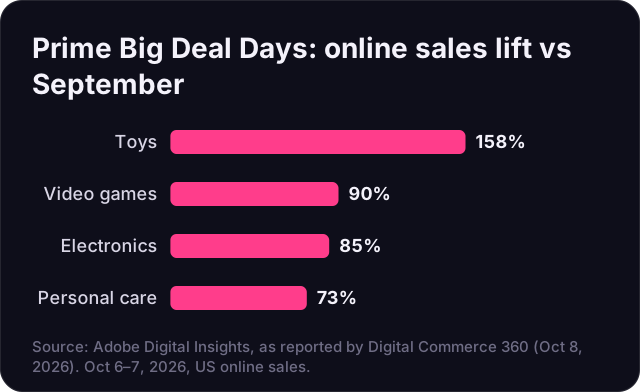
Adobe compared sales during the two days with average September 2026 levels. Toys more than doubled, and electronics, video games and personal care all saw large lifts. Within electronics, Adobe reported that headphones and speakers rose 300% and smartwatches 255% versus September, according to Digital Commerce 360.
Everyday goods also did well. Retail Dive, citing Adobe, reported increases of 55% in household cleaning and paper products, 45% in personal hygiene, 45% in pet food and 25% in apparel basics. Adobe also said the share of the most expensive goods sold in tracked categories rose 21% compared with the year-to-date average, led by electronics (+45%) and personal care (+34%). Shoppers were willing to trade up when the discount was right.
The deepest discounts, per Adobe, were in computers, televisions, electronics, toys and apparel. That fits the category lifts: the biggest jumps came where the markdowns were biggest.
Shopper behavior: mobile, BNPL and price comparison
- Mobile is the main checkout. Adobe called mobile "the dominant transaction channel," with 52% of online sales. Product pages, images and A+ content need to work on a small screen first.
- BNPL grew slowly. BNPL accounted for 6% of orders and $692.3 million in sales, up 4% year over year. Adobe expects BNPL to drive more than $1 billion in spending on Cyber Monday (Nov 30, 2026).
- Shoppers compared prices. Retail Dive reported Numerator survey findings that half of shoppers compared prices at other retailers such as Walmart, which ran its own competing sale, and that 74% cited inflation as a reason to shop the event. Numerator's figures come from its own panel and differ from Adobe's methodology, so treat them as directional.
What it means for sellers (our analysis)
Discounts are doing the work. Growth was solid but not spectacular, and it came with deeper markdowns than forecast. If your margins could not support a 20%-type discount in October, expect the same pressure around Black Friday and Cyber Monday. Decide now which SKUs you will discount, by how much, and which you will protect.
Gift categories have started early. Toys, video games and electronics jumped well above September levels. If you sell giftable products, holiday demand has already begun; check your FBA inventory against the recommended arrival dates for Black Friday week rather than waiting for November.
Essentials sellers should plan for repeat buying. Strong lifts in cleaning, hygiene and pet food suggest shoppers used the event to stock up. Subscribe & Save, bundles and multi-packs are worth testing before the next sale.
Watch your post-event data. Pull your own Business Reports for October 6–7 and compare conversion rate and ad cost per order with a normal week. Your account's numbers matter more than any national average.
Next steps checklist
- Compare your event sales, conversion and TACoS with the prior two weeks and with last October.
- List the SKUs that sold out or ran low and reorder for Black Friday–Cyber Monday now.
- Set a discount floor per SKU based on margin after fees, including Amazon's holiday peak fulfillment fees that start October 15.
- Check your listings on a phone: main image, title and first bullets.
- Plan your Black Friday and Cyber Monday ad budgets using the cost per click you actually saw on October 6–7.
How Atronia Innovations can help
We run Amazon, Walmart and TikTok Shop accounts for brands and factories, from deal planning and ad budgets to inventory timing for Q4. If you want a second look at your Prime Big Deal Days results and a plan for Black Friday, talk to our team or see our service plans.
Sources
- Digital Commerce 360 — Amazon Prime Big Deal Days in October drove $9.86 billion in online spending, Adobe says (Oct 8, 2026)
- Retail Dive — Online spend during Amazon's Prime Big Deal Days neared $10B in the US (Oct 9, 2026)
- MediaPost — Report: Amazon Prime Big Deal Days to reach $9.9B (Oct 5, 2026)