7 Practical Ways to Cut US Parcel Shipping Costs

Shipping is often one of the largest costs in a US e-commerce P&L after product and advertising, and it creeps up quietly: a slightly bigger box, a few address corrections, a label bought at retail rates. The good news is that most savings come from a handful of practical levers you control. Here are seven, roughly in the order we would tackle them.
1. Understand billable weight and right-size your packaging
Most parcel carriers charge the greater of actual weight and dimensional (DIM) weight. DIM weight is calculated as:
Length × Width × Height (inches) ÷ DIM divisor = DIM weight (lb), usually rounded up
Major carriers commonly use a divisor of 139 for many services, while USPS typically uses 166 and generally applies DIM pricing only to larger packages (over one cubic foot). Divisors, rounding rules and thresholds vary by service and by contract, so always verify the current rules with each carrier.
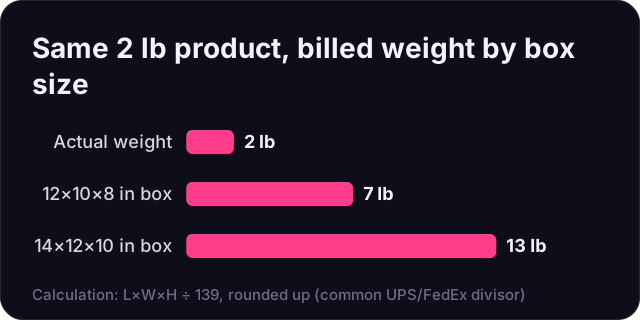
Example: a 2 lb product in a 14 × 12 × 10 in box has a DIM weight of 1,680 ÷ 139 ≈ 12.1, so it is billed as roughly 13 lb. Moving to a 12 × 10 × 8 in box gives 960 ÷ 139 ≈ 6.9, or about 7 lb, for the same product. That is a big difference on every order.
- Audit your top 10–20 SKUs by volume and measure the box actually used.
- Stock a few box sizes that fit your catalog instead of one “universal” carton.
- Consider poly mailers or padded envelopes for soft, non-fragile items.
- Run your numbers through our free dimensional weight calculator.
2. Watch the weight breaks
Parcel rates step up at weight boundaries, and most carriers round up to the next full pound. A package at 1 lb 1 oz is usually billed as 2 lb. For lightweight services, some carriers price by the ounce up to just under one pound, so crossing the 16 oz line can mean a noticeable jump.
Weigh your packed orders (product + box + filler + inserts + label), not just the product. Swapping heavy filler, trimming inserts or using a lighter mailer can pull a parcel back under a break.
3. Compare regional and last-mile carriers with national carriers
National carriers are not always the cheapest option for every lane. Regional and last-mile carriers can be very competitive in the areas they cover, especially for lightweight residential parcels. Cost depends on the zone (distance from origin to destination) and on your order density in a given area.
Pull a few months of order data, group by destination region and weight, and compare rates carrier by carrier. Also compare delivery speed, coverage and tracking quality, not just price.
4. Use negotiated or discounted rates instead of retail
Buying labels at retail counter prices is the most expensive way to ship. Commercial and negotiated rates are often meaningfully lower. You can reach them through your own carrier account (usually requires volume), through shipping software, or through a label provider that aggregates volume across shippers. Review contract terms carefully: minimums, accessorial fees and DIM divisors can matter as much as the base discount.
5. Cut avoidable surcharges
Surcharges can quietly add a lot to your bill. The most common ones you can influence:
- Address correction: validate addresses at checkout or before label creation.
- Residential delivery: some services charge extra for residential addresses; compare services built for home delivery.
- Additional handling / oversize: triggered by long sides, heavy weight or non-standard packaging (e.g. non-carton packages). Know each carrier’s thresholds and design packaging to stay under them.
- Peak and fuel surcharges: harder to avoid, but factor them into your pricing.
Surcharge names, amounts and thresholds change regularly, so check each carrier’s current service guide.
6. Ship from the right place
Zones drive cost. If you ship everything from one coast, orders to the other coast land in the highest zones. Splitting inventory between two locations (for example, West and East or Central) can shorten average zones and delivery times. Look at where your customers are, then weigh lower shipping costs against extra inventory, storage and transfer costs.
7. Rate-shop every shipment and track results
Shipping software can compare rates across carriers and services for each order and pick the cheapest option that meets your delivery promise. Set rules by weight, destination and service level instead of choosing manually.
Then measure: on-time rate, damage and loss rate, and cost per order by carrier. File claims for lost or damaged parcels and late deliveries where the service includes a guarantee, within each carrier’s deadline. Invoice audits often catch billing errors and incorrect surcharges.
Summary: effort vs. impact
| Lever | Effort | Typical impact |
|---|---|---|
| Right-size packaging (DIM weight) | Low–Medium | High for bulky, light items |
| Weight-break awareness | Low | Medium |
| Regional / last-mile carriers | Medium | Medium–High |
| Negotiated / discounted rates | Low | High |
| Reduce avoidable surcharges | Low–Medium | Medium |
| Ship-from location / inventory placement | High | Medium–High |
| Rate shopping, tracking & claims | Medium | Medium |
Impact depends on your products, order profile and destinations, so test changes on real orders before rolling them out.
Quick start: measure your five best-selling SKUs, calculate billable weight for each, and estimate savings with our shipping savings estimator.
How Atronia Innovations can help
We provide discounted shipping labels with UniUni, GOFO, SwiftX and USPS for US last-mile delivery, and FedEx, UPS, ePost and DHL for international shipments. Pickup can be arranged with our help or by you. We can review your order profile and suggest the right carrier mix. Request a shipping quote, or see our logistics services.