Shopify Q3 2026: GMV Up 30% to $119B, B2B Up 74%, AI Orders Up 3.3x

Brand websites are not losing ground to marketplaces. On November 3, 2026, Shopify reported that merchants on its platform sold $119 billion of goods in the third quarter, up about 30% from a year earlier, with B2B sales growing even faster and AI-driven orders more than tripling. For brands deciding how much to invest in their own store versus Amazon or Walmart, here is what the numbers show.
The headline numbers
According to Shopify's Q3 2026 press release (Nov 3, 2026):
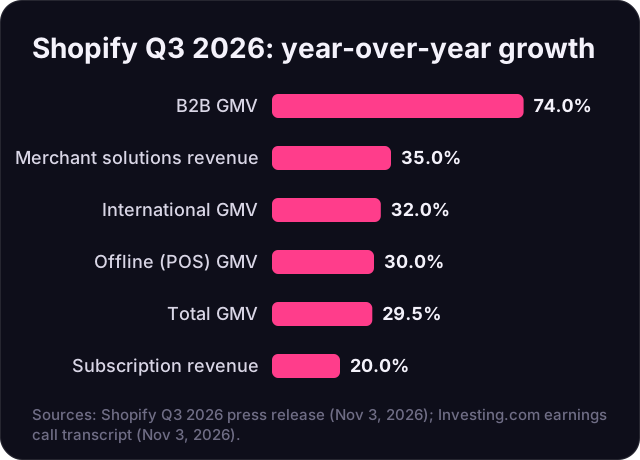
- GMV (gross merchandise volume) was $119.1 billion, compared with $92.0 billion a year earlier, an increase of 29.5% (calculation from the release figures).
- Revenue grew 32% to $3.74 billion; merchant solutions revenue reached $2.91 billion and subscription revenue $836 million.
- Free cash flow margin was 22%, up from 18%.
- Q4 outlook: revenue growth "at a low-thirties percentage rate."
President Harley Finkelstein said: "We powered $119 billion in GMV, while continuing to build commerce into every surface, every agent, and increasingly, everywhere."
Where the growth came from
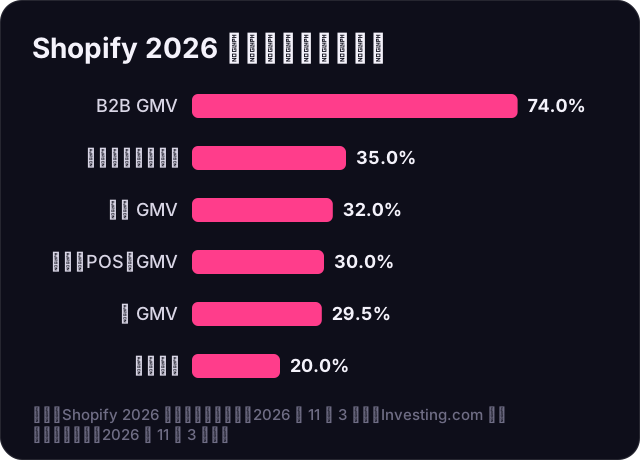
On the earnings call, as transcribed by Investing.com (Nov 3, 2026), Shopify said international GMV grew 32%, B2B GMV grew 74% and offline (point-of-sale) GMV grew 30%. Merchant solutions revenue rose 35% and subscription revenue 20%. sec-api.io's filing analysis (Nov 4, 2026) reports Shopify Payments processed $81.4 billion, or 68% of GMV, up from 65% a year earlier.
AI shopping is showing up in the numbers
Finkelstein said on the call that "AI traffic is up 2.6x year-over-year. Orders are growing even faster at 3.3x." He added that AI channels send shoppers to product pages at 3x the rate of organic search, with 64% higher conversion, and that Shopify is "powering product discovery across all major AI channels, from ChatGPT to Microsoft to Muse." Management said it is not trying to pick winners among AI agents and wants merchants to sell through all of them.
| Shopify Q3 2026 indicator | Figure | Source |
|---|---|---|
| GMV | $119.1B (+29.5%) | Press release (calculated) |
| Revenue | $3.74B (+32%) | Press release |
| B2B GMV growth | +74% | Earnings call via Investing.com |
| Shopify Payments share of GMV | 68% (vs 65%) | sec-api.io |
| AI-driven traffic / orders | 2.6x / 3.3x year over year | Earnings call via Investing.com |
| Adjusted EPS vs consensus | $0.49 vs $0.47 | Investing.com |
Despite beating profit estimates, shares fell after the report, Investing.com and sec-api.io note.
What it doesn't tell us
Shopify's figures cover all merchants on its platform worldwide, not just US brands, and they include very large merchants. A small brand's own store will not automatically grow 30%. Traffic still has to be earned through ads, content, email and search, which is why many brands keep marketplaces as their main volume channel while building their own store.
What it means for brands (our analysis)
Your own store is a growth channel, not just a brand page. With GMV growing about 30%, independent stores are taking share. A Shopify store also gives you customer data and repeat-purchase control that marketplaces don't.
B2B is the sleeper opportunity. 74% B2B growth suggests more brands are selling wholesale online. Factories and brands with distributor or retail customers can move those orders onto a B2B storefront.
AI channels reward clean product data. If AI-driven orders are tripling, structured catalogs matter. The same feed that powers Google free listings feeds many AI shopping surfaces.
Marketplaces and DTC work together. Most brands don't have to choose. Tools such as Amazon's multichannel tools make it easier to run both from one inventory.
Checklist for brands
- Compare your own-store growth with marketplace growth over the last four quarters.
- Clean up product titles, attributes and GTINs so AI and search channels can read them.
- Test a B2B or wholesale price list if you sell to retailers or distributors.
- Track AI referral traffic separately in your analytics.
- Keep inventory synced across your store and marketplaces before Black Friday.
How Atronia Innovations can help
We help brands build balanced US channels, from Amazon, Walmart and TikTok Shop to their own stores and Google, with shared catalogs and inventory. Talk to our team about your channel mix.