Walmart Will Enforce Return Rate by Item Starting January 2027
Walmart is about to judge returns item by item, not just account by account. On November 6, 2026, Walmart Marketplace posted a release note saying that from January 2027, individual items with high seller-accountable return rates may be warned or temporarily unpublished, even if the seller's overall Return Rate is within the standard. With holiday returns arriving in January, the timing matters.
What Walmart announced
In its release note “Prepare for item-level Return Rate enforcement” (Nov 6, 2026), Walmart says it "will provide Return Rate metrics at the item level in addition to your overall Return Rate." It explains that this "allows Walmart to take targeted action rather than automatically affecting your entire catalog," and states: "Beginning in January 2027, items with high rates of seller-accountable returns may receive a warning or be temporarily unpublished, even if your overall Return Rate meets the Seller Performance Standard."
Walmart's Return Rate guide, updated the same day, adds that "Item-level actions apply only to items flagged for high returns," while "broader or repeated performance issues may result in additional action under Seller Performance Standards." The change was also reported by Seller Essentials on November 10, which notes that a Walmart email to sellers on November 9 described the timing only as "in the next few months."
The rules in one table
The account-level standard itself is unchanged. Walmart first announced the Return Rate metric in its January 2026 seller newsletter, defining it as the share of delivered items returned "due to a seller-related issue over the past 60 days." Here is how the rules now fit together, according to Walmart's guide:
| Rule | What Walmart says |
|---|---|
| Overall Return Rate, new inventory | 6% or below |
| Overall Return Rate, Resold inventory | 9% or below |
| Measurement window | Items delivered in the past 60 days |
| What counts | Seller-accountable returns: defective, damaged, incorrect item, arrived late |
| Item-level action (from January 2027) | Warning or temporary unpublishing of the flagged item |
| Item-level threshold | Not published by Walmart |
| WFS items | Walmart says most metrics, including Return Rate, are met for you |
Note what is missing: Walmart has not said what item-level rate counts as "high." Treat any specific number you see elsewhere as a guess until Walmart publishes one.
Why returns deserve attention now
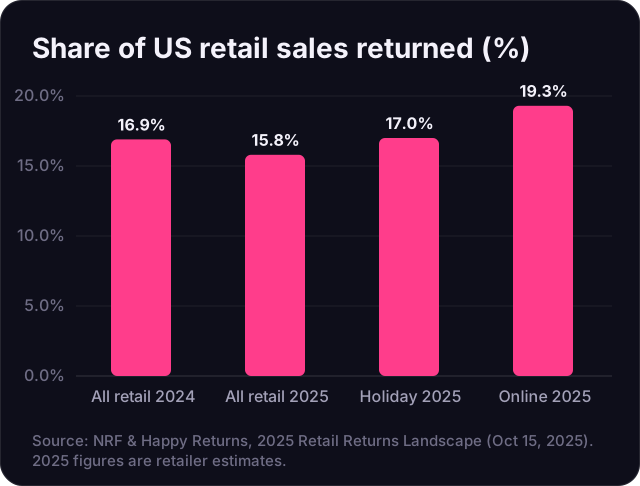
Returns are a bigger issue online than in stores. According to the NRF and Happy Returns 2025 Retail Returns Landscape (Oct 15, 2025), retailers expected 15.8% of 2025 sales ($849.9 billion) to be returned, compared with 16.9% in 2024. They estimated that 19.3% of online sales would be returned and expected 17% of holiday sales to come back.
Most of those returns are not the seller's fault (for example, "changed my mind"), and Walmart counts only seller-accountable reasons. But January is when holiday returns land, which is exactly when the new item-level enforcement begins.
What it means for sellers (our analysis)
- A good account average no longer protects every SKU. One problem item can be unpublished while the rest of your catalog is fine. Large catalogs with a few weak products are most exposed.
- Bestsellers carry the most risk. If a top seller is unpublished during January, the revenue loss is far larger than the return cost itself.
- WFS sellers have less to worry about. Walmart's guide says that with Walmart Fulfillment Services, most metrics including Return Rate are met for you. Seller-fulfilled items need the most work.
- Listings are part of returns control. "Incorrect item" and "not as described" returns often start with wrong photos, sizes or UPCs.
Checklist before January
- In Seller Center, go to Returns and select View returns insight to see each item's Return Rate, units returned and top return reasons.
- Sort by units returned and fix the top 10 items first: photos, size charts, specs and compatibility notes.
- Check UPC-to-product matching for any "incorrect item" returns.
- Upgrade packaging for items with "damaged" returns and review carriers with repeated handling problems.
- Review lag times and transit settings so "arrived late" returns don't pile up during peak.
- Remember that returns older than 60 days stop counting, so fixes made now take time to show in your rate.
- Confirm your return settings match the Walmart returns policy and our seller performance standards guide.
How Atronia Innovations helps
We manage Walmart Marketplace accounts end to end, including listing quality, returns analysis and performance monitoring, so one problem SKU doesn't take down your best sellers. Learn about our Walmart management plans or ask us for a returns review.
Sources
- Walmart Marketplace Learn — Prepare for item-level Return Rate enforcement (Nov 6, 2026)
- Walmart Marketplace Learn — Performance dashboard: Return Rate (updated Nov 6, 2026)
- Walmart Marketplace — Seller newsletter (January 2026)
- Seller Essentials — Walmart item-level return rate (Nov 10, 2026)
- NRF — Consumers expected to return nearly $850 billion in merchandise in 2025 (Oct 15, 2025)