NRF Forecasts $1.013 Trillion Holiday Season, Up 4.2%
The National Retail Federation expects another trillion-dollar holiday season. On October 15, 2026, NRF forecast that US retail sales in November and December will grow 4.2% to $1.013 trillion, faster than last year's 3.1%. Online forecasts released by other firms point to growth roughly twice as fast. Here is what NRF said, how it compares with other forecasts, and what it means for sellers.
This follows our earlier roundup of 2026 holiday e-commerce forecasts from Adobe, Deloitte and eMarketer; NRF's forecast was not yet out when we published it.
What NRF forecast
| NRF holiday measure | 2025 actual | 2026 forecast |
|---|---|---|
| Holiday retail sales (Nov 1–Dec 31) | $972 billion (+3.1%) | $1.013 trillion (+4.2%) |
| Seasonal hiring | About 356,000 | 325,000–375,000 |
Sources: Chain Drug Review (Oct 15, 2026), WWD via Yahoo Finance (Oct 15, 2026) and Home Textiles Today (Oct 15, 2026). NRF's holiday figures exclude auto dealers, gasoline stations and restaurants.
- Part real growth, part prices. WWD reported that nearly half of the growth comes from real consumer spending, with inflation accounting for the rest. Home Textiles Today put real growth at about 2% and said NRF expects core goods inflation to average 2.6% in 2026, up from 1.6% in 2025.
- A split consumer. NRF chief economist Mark Mathews said "the divide in spending is becoming more pronounced," and that the experience of individual households will vary significantly.
- Still prioritizing the holidays. NRF CEO Matthew Shay said: "Consumers continue to prioritize the holiday season while carefully managing their finances."
How it compares with online forecasts
WWD gathered several other forecasts alongside NRF's. They measure different things over different periods, but the direction is the same: online is expected to grow faster than retail overall.
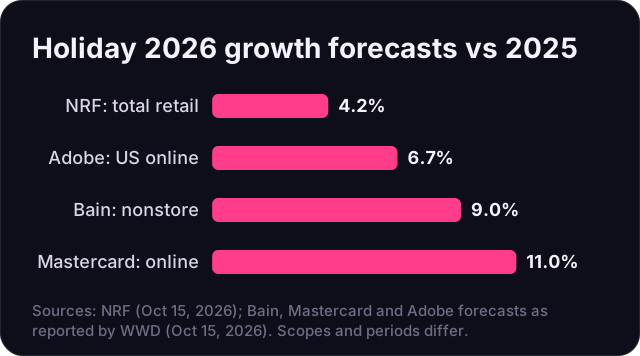
Deloitte, also cited by WWD, expects US holiday e-commerce of $316.1–$318.9 billion for November 2026 through January 2027, up 7.5%–8.4%, against total retail growth of 4%–4.8%. Adobe forecasts $275.1 billion in US online spending in November and December, up 6.7%.
A shorter view of the calendar
NRF's season runs from November 1 to December 31. Within it, the key dates for online sellers are Thanksgiving on November 26, Black Friday on November 27 and Cyber Monday on November 30, 2026. Because Thanksgiving falls relatively late, there are less than four weeks between Cyber Monday and Christmas, which leaves less time to restock bestsellers and less room for shipping delays. Marketplace inventory deadlines for Black Friday week usually fall in October, so the decisions that matter most are being made now, not in late November.
What it means for sellers (our analysis)
Growth is there, but some of it is price. With about half of NRF's 4.2% coming from inflation, unit volume may grow less than revenue. Plan inventory on units, not just dollars.
Online should outpace stores again. Every online forecast above sits well above NRF's total, and September Census data showed nonstore sales up 8.2% year over year; see our September retail sales article. Make sure your ads, inventory and customer service can handle that pace through December.
Know which shopper you serve. A more divided consumer means value-focused shoppers will chase deals while higher-income shoppers keep spending. Price-sensitive products need sharp offers; premium products need strong content and fast delivery.
Plan for fewer helping hands. Seasonal hiring could be lower than last year's 356,000 at the low end of NRF's range. If you rely on 3PLs or carriers, confirm their peak capacity and cutoffs now.
Checklist for the next six weeks
- Set unit-based sales targets for November and December, not just revenue targets.
- Confirm inventory arrival dates for Black Friday (November 27) and Cyber Monday (November 30).
- Split your offers: sharper deals for value products, bundles or gifting for premium items.
- Lock in carrier and 3PL pickup schedules and holiday cutoffs.
- Plan ad budgets with room to scale on the biggest days.
How Atronia Innovations can help
We plan and run Q4 for brands and factories on Amazon, Walmart and TikTok Shop, including deals, ads, inventory and discounted shipping labels. Talk to our team about your holiday plan.
Sources
- Chain Drug Review — NRF forecasts holiday sales to top $1 trillion in 2026 (Oct 15, 2026)
- WWD via Yahoo Finance — NRF forecasts 4.2% US holiday sales gains (Oct 15, 2026)
- Home Textiles Today — NRF forecasts more than $1 trillion in holiday spending (Oct 15, 2026)
- NRF — Winter holiday data and trends